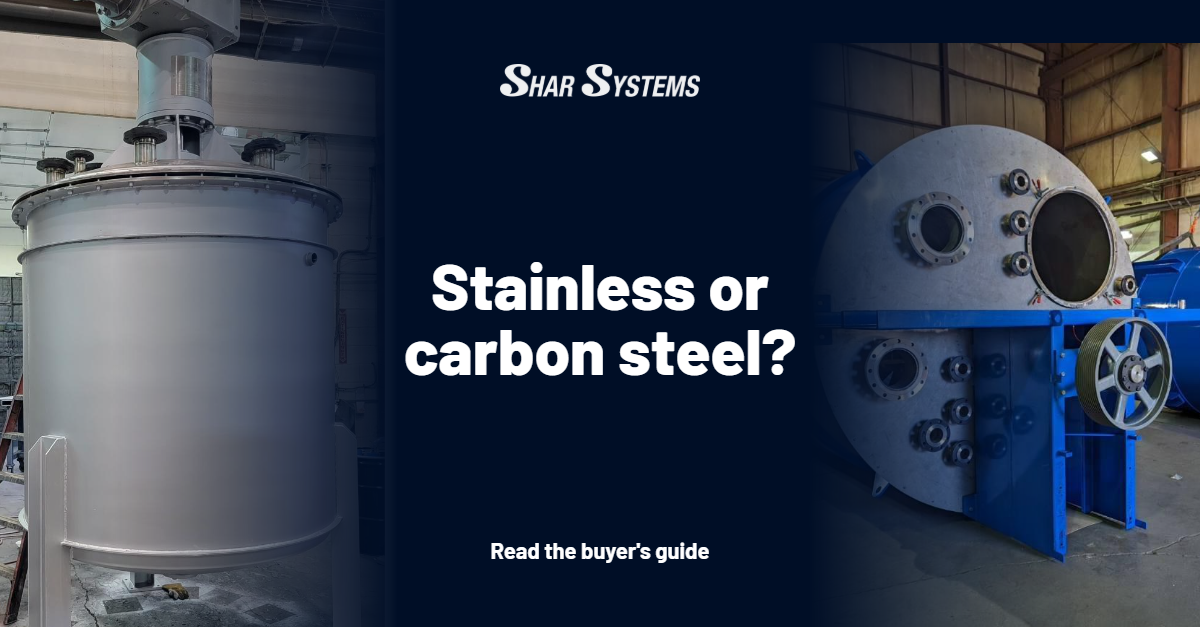
Choosing the right storage tank is one of those decisions that looks simple from the outside and gets complicated fast once you're in it. Material, capacity, chemistry, budget, and how the tank will fit into your existing process all pull in different directions, and the wrong call can mean corrosion issues, contamination risk, or a tank you outgrow within a year.
At Shar Systems, we've spent decades building custom storage tanks for manufacturers who can't afford to get this wrong, from cosmetics and personal care formulators who need a contamination-free vessel, to chemical processors handling corrosive materials in bulk. This guide walks through how to think about stainless steel tanks, carbon steel tanks, and custom-built alternatives, so you can make the choice with confidence instead of guesswork.
What to Consider Before Choosing a Storage Tank
Before comparing materials, it helps to pin down a few basics:
- What's going in the tank. Corrosive chemicals, food-grade ingredients, and abrasive solids each demand different tank properties.
- Capacity today and in two years. Storage tanks can be built anywhere from 1 gallon to 10,000 gallons; sizing for growth up front is almost always cheaper than retrofitting later.
- Environment and regulatory requirements. Outdoor exposure, temperature swings, and industry-specific sanitation standards (cosmetics and pharma in particular) narrow the field quickly.
- Total cost of ownership, not just sticker price. A cheaper tank that corrodes in five years often costs more than a stainless tank that lasts thirty.
Once those are clear, the material decision gets a lot more straightforward.
Stainless Steel Tanks
Stainless steel tanks are the go-to choice when the contents of the tank are corrosive, sensitive to contamination, or need to stay chemically pure. The chromium content in stainless steel forms a passive oxide layer that resists rust and corrosion far better than standard steel, which is why stainless steel tanks show up constantly in:
- Cosmetics and personal care manufacturing
- Chemical processing
- Adhesives, sealants, and coatings production
Stainless steel tanks also hold up well outdoors and in washdown-heavy environments, and they're easier to keep compliant with strict sanitation standards since the smooth, non-porous surface doesn't harbor bacteria the way some alternative materials can. The tradeoff is upfront cost: stainless steel tanks generally cost more to fabricate than carbon steel, but for the right application, the lifespan and reduced maintenance more than make up the difference.
Carbon Steel Tanks
Carbon steel tanks remain one of the most cost-effective ways to store large volumes of non-corrosive liquids and solids. They offer excellent structural strength, which makes them a strong fit for large-capacity storage where the contents don't pose a corrosion risk.
Carbon steel tanks are common in glass, cement, and ceramics production, as well as general industrial storage where budget and strength matter more than chemical resistance. With a protective coating or lining, carbon steel tanks can also be adapted for mildly corrosive applications, extending their usefulness without the full cost jump to stainless.
The short version: if your process doesn't involve corrosive or high-purity materials, carbon steel tanks typically deliver the best value per gallon of capacity.
Why Experience Matters in Tank Fabrication
Tank fabrication is unforgiving of shortcuts. A weld seam or material mismatch that seems minor on day one can turn into a leak, a contamination event, or a structural failure years down the road. That's where a manufacturer's track record matters as much as the spec sheet.
Shar Systems has been designing and building custom tanks and industrial mixing equipment for decades, with several team members bringing more than 30 years of hands-on experience to every project. We're proud that equipment we built in the 1970s and '80s is still running reliably in customers' facilities today — a track record that speaks to how we engineer and fabricate every tank, whether it's carbon steel, stainless steel, or a custom material combination. Every tank is designed and manufactured in the USA, and for many of our customers, we handle delivery and installation personally rather than shipping it off and hoping for the best.
Getting the Right Tank for Your Process
Stainless steel tanks, carbon steel tanks, and every custom variation in between exist to solve a specific problem: keeping your materials safely and reliably contained through years of production. The right choice depends on what's going into the tank, how it needs to perform, and how your process might grow.
If you're weighing stainless steel against carbon steel, sizing a custom tank for a new line, or just not sure where to start, talk with our team. We'll walk through your process requirements and help you land on a tank built for the job, not just the closest thing off the shelf.