In plastics and composites manufacturing, a finished part's strength is decided long before it reaches the mold. It is decided at the mixer. Uneven dispersion, poorly wetted fibers, or a single trapped air pocket can turn a structurally sound design into a part that fails under load. For manufacturers producing thermoset resins, fiber-reinforced composites, or filled plastics, mixing is where product quality is won or lost.
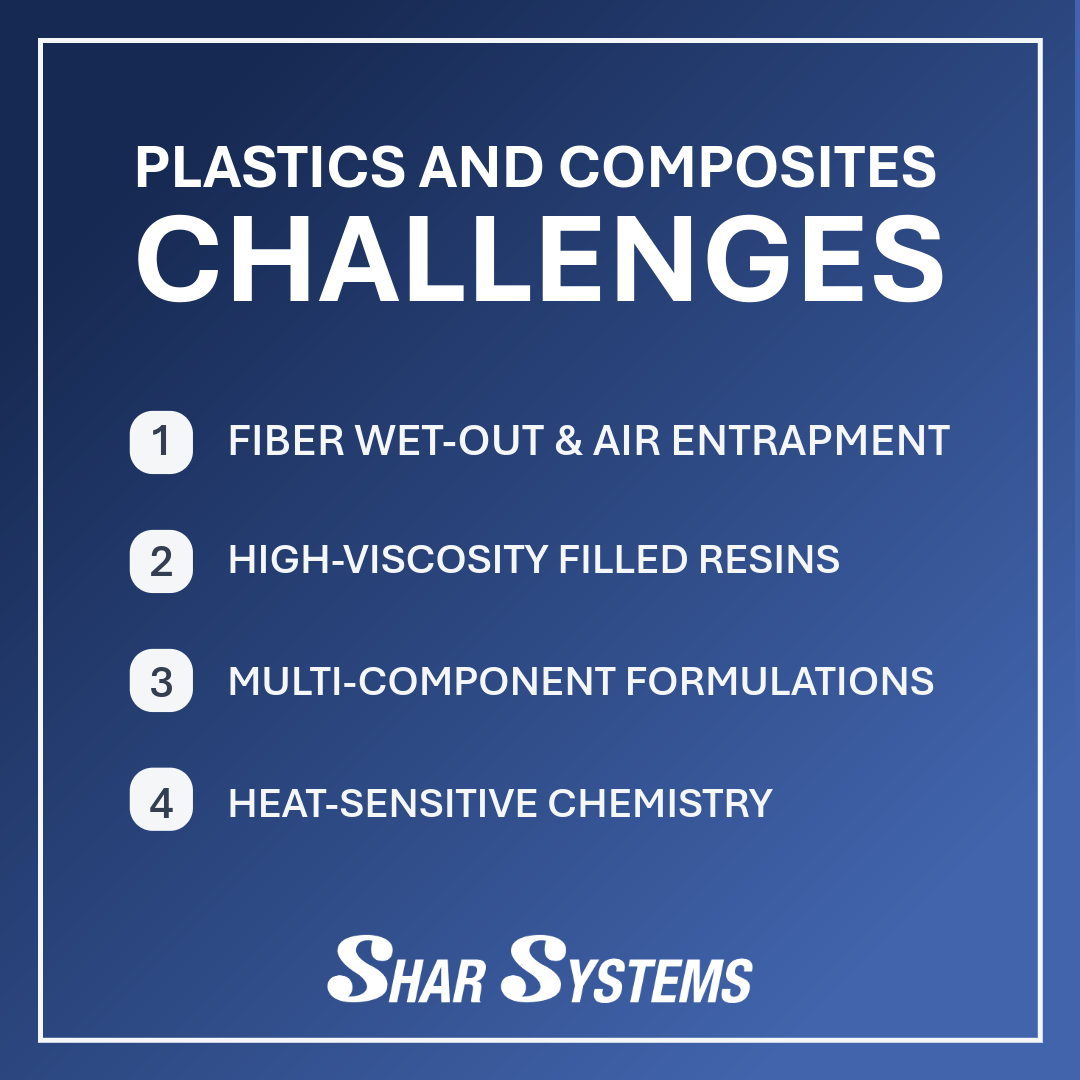
Here are the challenges that come up most often, and what actually solves them.
Fiber wet-out and air entrapment
This is the difference between strong composite parts and weak ones. When reinforcing fibers aren't fully coated with resin, or when air stays trapped in the blend, the result is voids, weak points, and surface defects that no downstream process can fix. Standard agitation often makes it worse by folding in more air than it removes.
The fix is controlled agitation paired with vacuum. Mixing under vacuum pulls entrained air out of the batch while the resin fully wets each fiber, producing a denser, stronger, more uniform part.
High-viscosity, filled resins
Filled and reinforced resin systems are thick, and they resist agitation. Without enough torque and the right agitation profile, the mixer either stalls or leaves separation and incomplete dispersion behind.
Multi-shaft mixers handle this by pairing a slow-speed anchor that keeps the whole batch moving with a high-speed disperser that drives shear where it is needed. That combination moves viscous, non-Newtonian materials without leaving dead zones in the tank.
Multi-component formulations
A single batch might hold base resin, catalyst, colorants, stabilizers, and fillers like glass or talc, and each needs to end up evenly distributed without over-shearing the mix. A poor balance produces inconsistent color, uneven curing, or degraded mechanical properties.
Programmable, tailored agitator configurations allow shear to be matched to the formulation instead of forcing every material through the same aggressive profile.
Heat-sensitive chemistry
Thermoset plastics like polyesters, epoxies, and vinyl esters are sensitive to temperature. Too much heat during mixing risks premature curing or degradation before the material ever leaves the tank.
Jacketed vessels with integrated heating and cooling hold the batch in its safe range throughout the mix, which matters most for reactive or exothermic systems.
Solving it starts with the right equipment
Most plastics and composites mixing problems trace back to equipment built for a different job. Shar Systems designs custom mixers around each formulation and plant setup, including multi-shaft systems, high-viscosity dispersers, vacuum capability, and integrated thermal control.
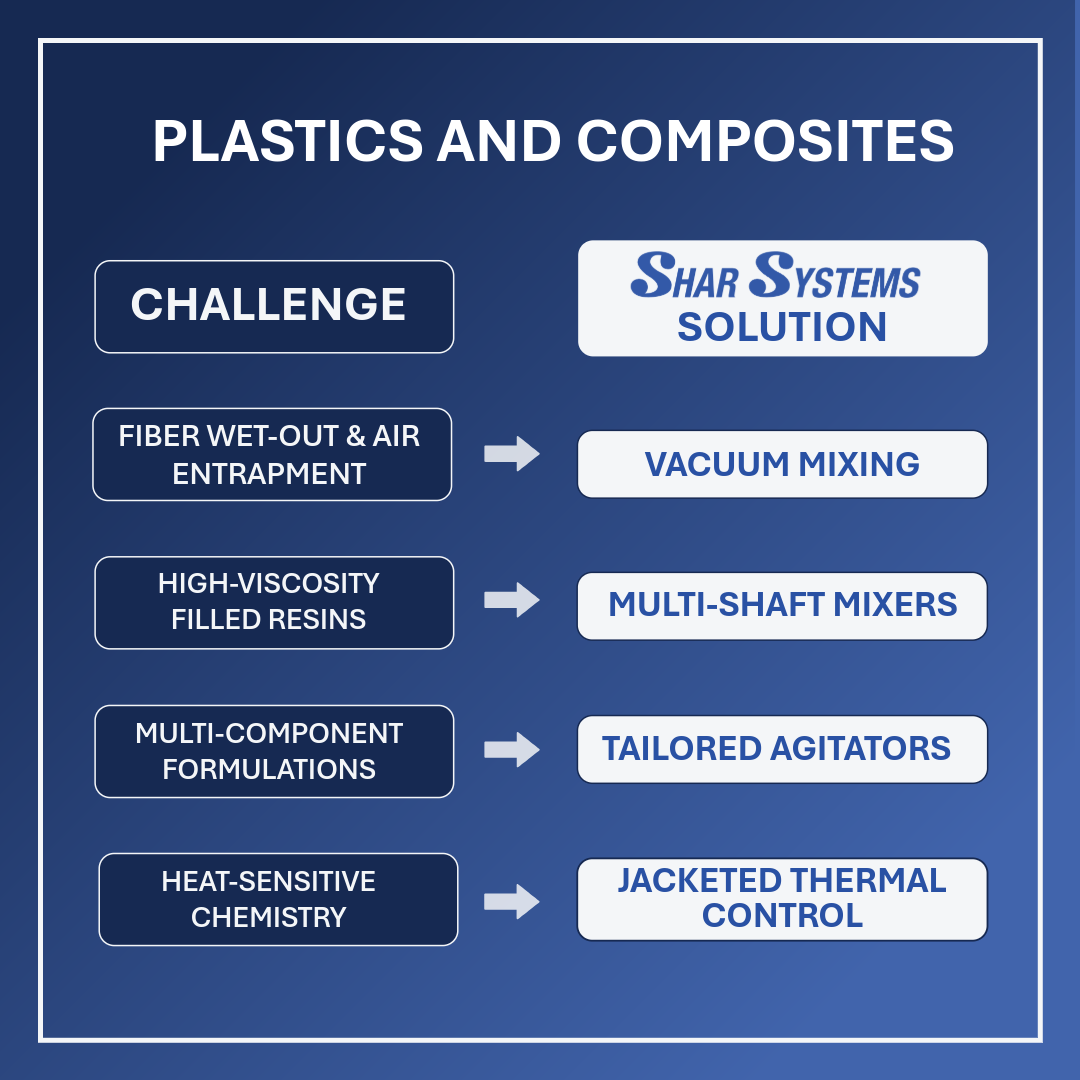
Shar Systems designs custom mixers around each formulation and plant setup, including multi-shaft systems, high-viscosity dispersers, vacuum capability, and integrated thermal control.
Learn more about how Shar Systems engineers mixing systems for plastics and composites.