If you've ever had a batch come out grainy, separated, or just... off, there's a good chance the mixer is the culprit, not the formula. One of the most common decisions cosmetic manufacturers face early on is whether a single-shaft mixer will do the job, or whether the formula really needs a multi-shaft system. Get it wrong and you're looking at inconsistent texture, batch-to-batch variability, or products that just don't hold up on the shelf.
Here's how to think through the choice.
What a Single-Shaft Mixer Does Well
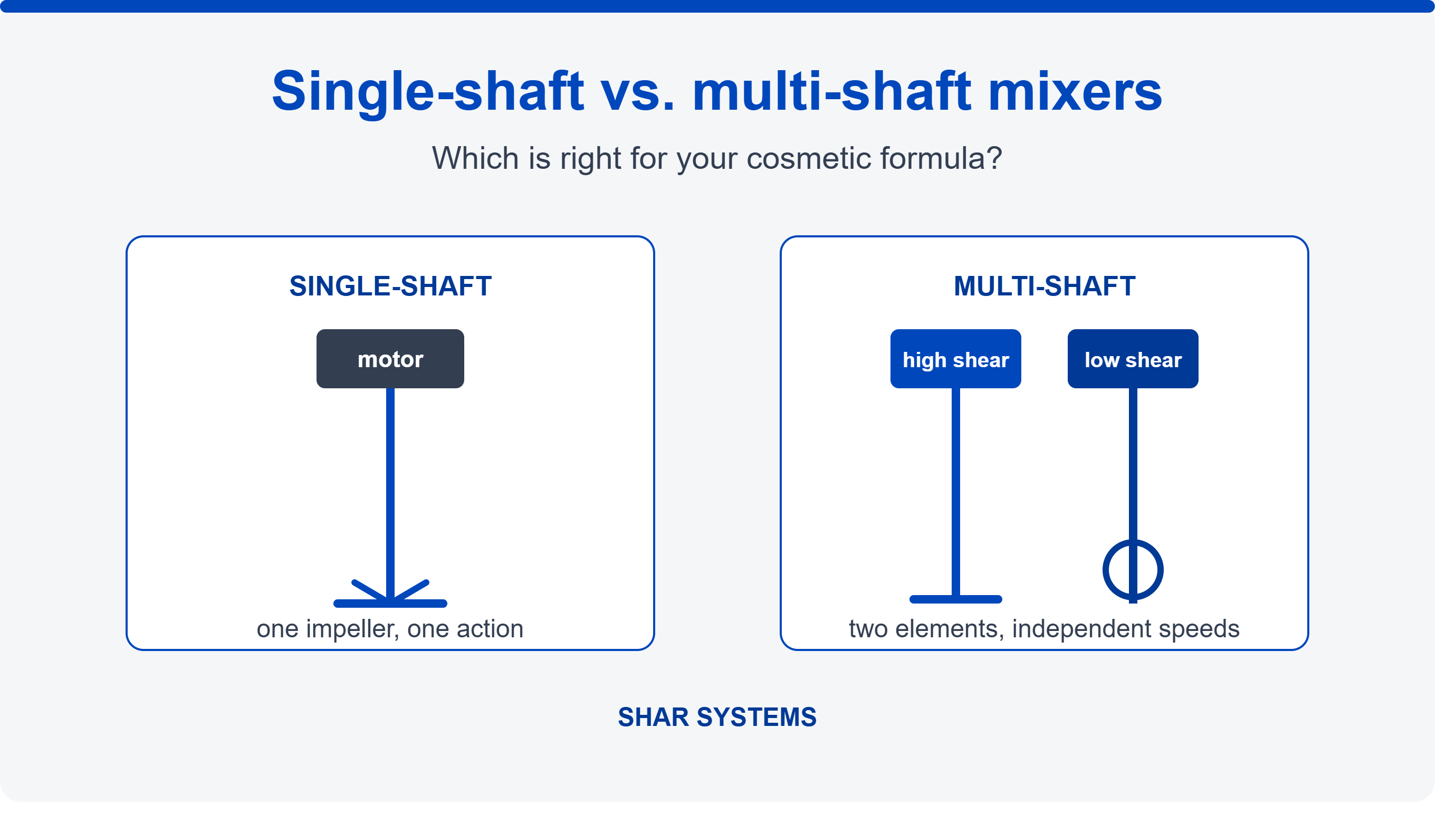
A single-shaft mixer uses one impeller, one motor, one mixing action. It's simpler, often more affordable, and works fine for:
- Low-to-medium viscosity liquids
- Simple two-phase blends
- Products that don't require simultaneous high-shear and low-shear action
- Smaller batch sizes or early-stage formulation work
Think basic hand sanitizers, some toners, or simpler liquid blends where you're not fighting phase separation or aeration.
Where Single-Shaft Falls Short
Cosmetic formulas get complicated fast. The moment you're combining oils, water, waxes, and active ingredients — which is most creams, lotions, and serums — a single impeller usually can't do everything at once. You need high shear to disperse pigments or break down waxes, and gentle folding to avoid whipping air into the batch. One shaft, one speed profile, can't deliver both.
That's usually when manufacturers start seeing:
- Oil/water separation
- Gritty texture from undispersed pigments or fillers
- Air pockets that mess with appearance and stability
- Inconsistent viscosity from batch to batch
What a Multi-Shaft Mixer Adds
A multi-shaft mixer runs two or more independent mixing elements at different speeds and shear profiles, at the same time. Typically that means a high-shear disperser blade working alongside a slower-speed anchor or scraper.
This matters for cosmetics because it lets you:
- Disperse pigments, actives, and powders thoroughly (high shear) while folding the batch gently to prevent aeration and over-shearing (low shear)
- Maintain consistent heat transfer across a viscous, non-Newtonian product
- Handle thicker products — body butters, cleansing balms, conditioning masks — without stalling out or leaving unmixed pockets near the vessel wall
Multi-shaft systems also tend to be more customizable. You can add heating/cooling jackets, vacuum lids, or CIP components more easily, which matters if you're scaling up or need FDA/USDA-grade sanitary design.
Quick Comparison
| Single-Shaft | Multi-Shaft | |
|---|---|---|
| Best For | Simple liquids, small batches | Emulsions, creams, viscous or multi-phase formulas |
| Shear Profile | One speed/action | Independent high-shear + low-speed simultaneously |
| Aeration Control | Limited | Better, especially with vacuum options |
| Scalability | Works at small scale | Built for lab-to-production scaling |
| Customization | Fewer options | Jackets, vacuum, CIP, automation-ready |
| Typical Products | Toners, sanitizers, simple blends | Creams, lotions, serums, masks, foundations |
So Which One Do You Need?
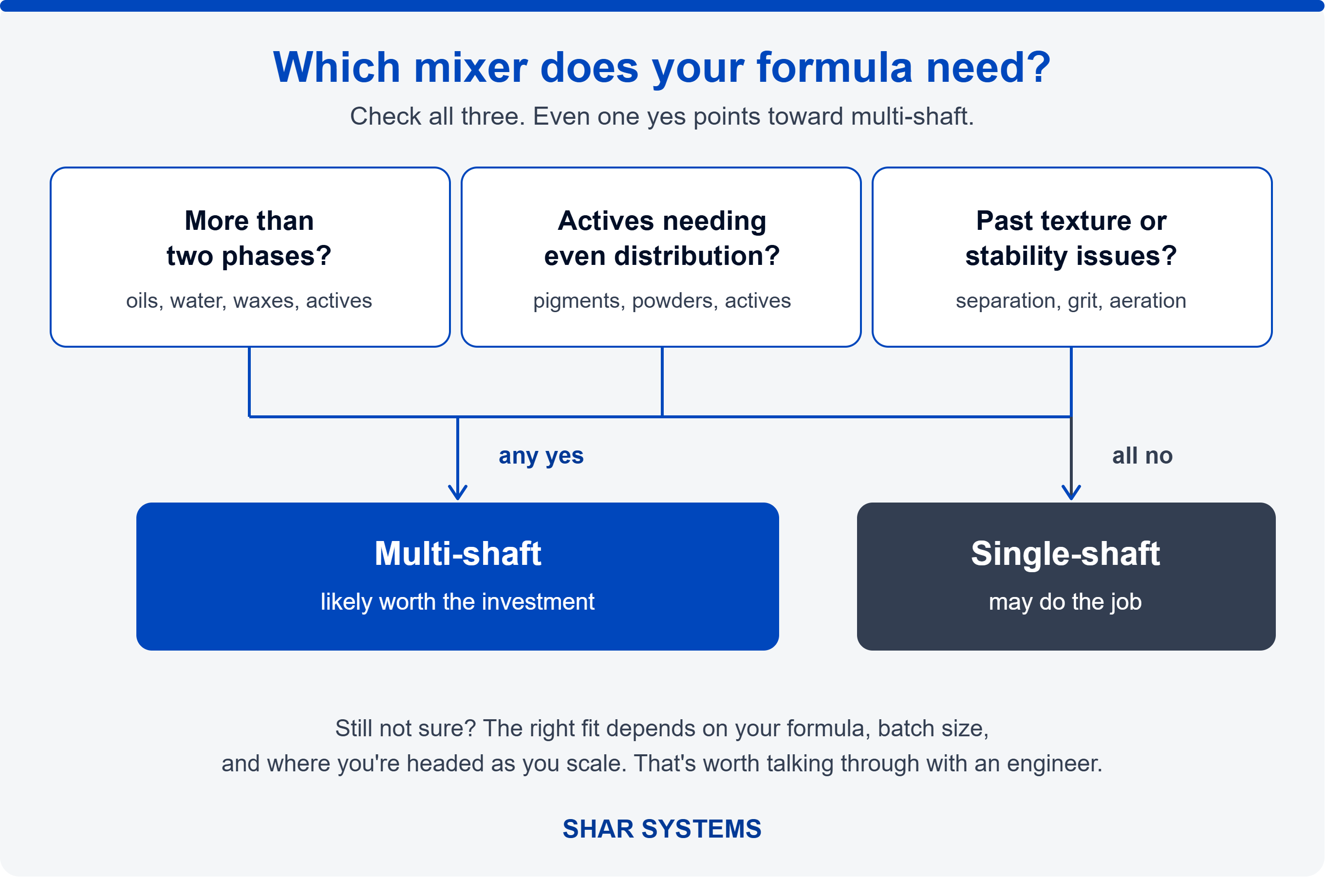
A good rule of thumb: if your formula has more than two phases, includes actives that need even distribution, or you've had stability or texture complaints in the past, a multi-shaft system is probably worth the investment. If you're working with a simple, low-viscosity product at small volume, single-shaft may still get the job done. The honest answer, though, is that it depends on your specific formula, batch size, and where you're headed as you scale. That's the kind of thing worth talking through with an engineer rather than guessing.
Not sure which setup fits your process? Send us a message, and we'll help you figure out the right mixing solution for your formula, whether that's a single-shaft setup or a fully custom multi-shaft system built to your specs.